


Welcome to The Gigacasting Newsletter
New here? Subscribe
My Take on the Gigacasting Market, in Foundry Magazine
For the World Foundry Congress 2026 edition of Foundry Magazine, I wrote a 6 pages guest piece on where Gigacasting stands today and where it is heading. It is titled "Die Casting in the Spotlight of Giga- and Megacasting".
The short version is that the Gigacasting wave is far from over, but it has split into two very different stories. In China, capacity grew faster than the market: as of mid-2026, only around six out of ten machines announced worldwide are actually on a factory floor, and Chinese utilisation would stay below 50 percent even if demand almost tripled by 2030. In Europe and North America, many orders are still waiting to be installed, and Chinese carmakers are building cars locally.
The article also covers why the race to 20,000 tons misses the point, why magnesium will come but later than many announcements suggested, and what all this means for foundries as Gigacasting becomes increasingly OEM-centric.
Thanks Kathrin Kinne and Katharina Schmitt for the opportunity!

Duoli's Jintan Gigacasting Plant Develops Rear Underbodies For SAIC And GM
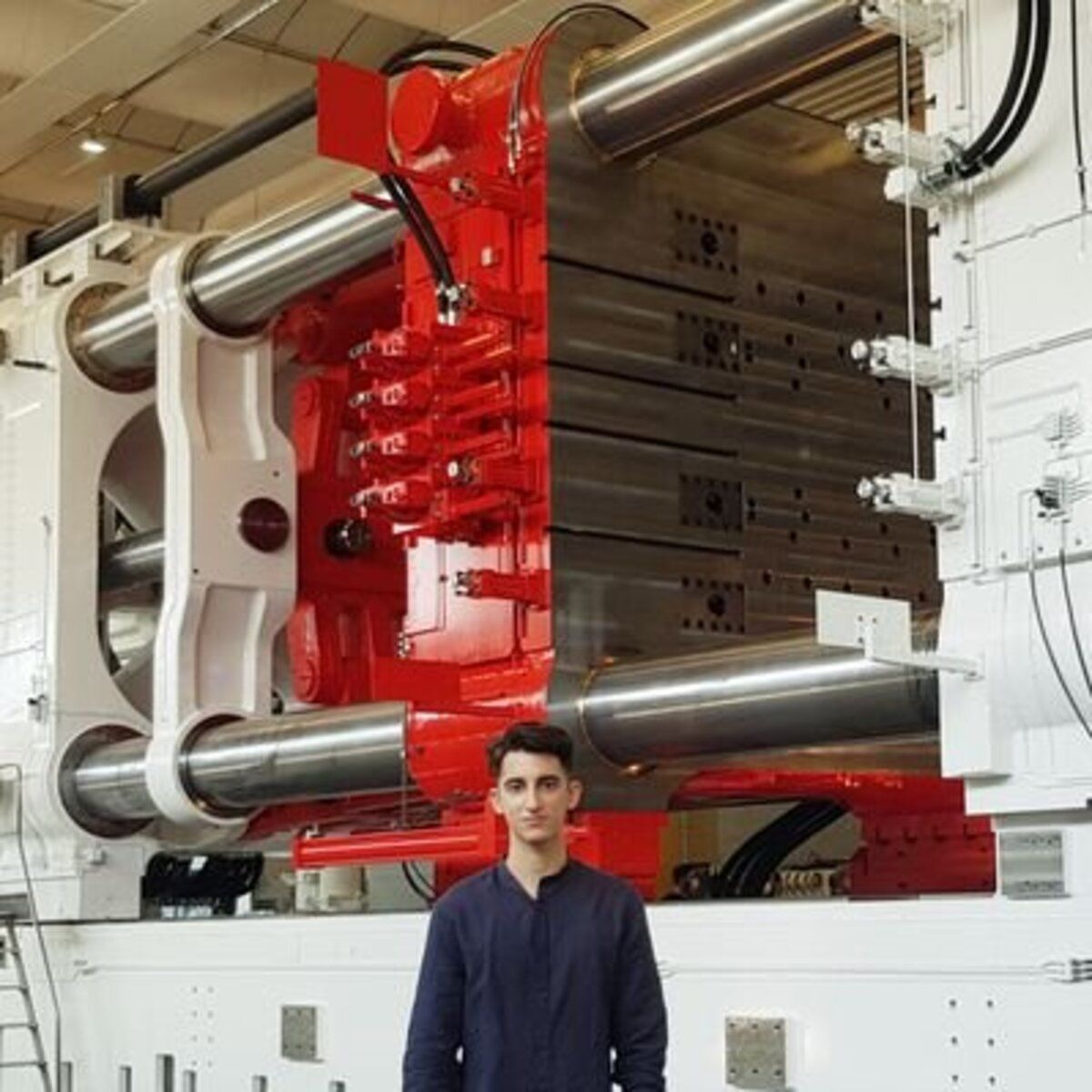
Duoli Technology's Gigacasting plant in Jintan, a district of Changzhou in China's Jiangsu province, is running its three large die-casting machines at full load and turning out up to 35,000 one-piece floor castings a month, according to a report published by the Jintan District government on 6 October 2026.
The plant is now co-developing two new underbody castings with SAIC and GM, with trial production due in the fourth quarter of 2026 and volume production phasing in from 2027.
The plant mainly supports the production of the Li Auto i6 (production figures in The Gigacasting Database). Molten aluminum is injected into the die under high pressure, and the RUB Gigacasting of the i6 comes out roughly every two minutes, after which a robot lifts it out and sends it on to trimming and finishing.
The plant says it has made 200,000 sets of floor castings so far this year, and that its sales have grown five- to six-fold from the same period last year.
Wu Guangjian, the plant's equipment director, explains the gain in simple terms: a floor that used to be assembled from more than 70 parts now comes out of the Gigacasting process as one. Where one floor used to take several hours, he says, the journey from die-casting to finished part now takes two to three hours.
Duoli puts the plant's yield above 90%. To hold it there, the plant stops one day a week to maintain its machines and dies, and gives every casting its own code in a manufacturing execution system (MES), the software that logs water temperature, die temperature and coolant flow in real time, so that a faulty part can be traced back to the machine and the shift that made it.
Coordinate Measuring Machines (CMM), blue-light scanning and routine line inspections then check the parts further down the line. Deputy general manager Lu Haiping calls Jintan the most automated plant in the Duoli group.

What has changed is the customer list. Jintan was set up to supply mainly Li Auto and the district government presents the two new floor parts as the point where its customers widen to traditional carmakers. Several of Duoli's global customers have also visited the plant this year. Looking ahead, Lu says Duoli aims to bring in two more large die-casting systems over the next quarter and into next year.
Duoli has built its Gigacasting business on Bühler machines. In March, at the China Die Casting Congress in Wuhan, Bühler announced a new Duoli order for further Carat 920 and Carat 720 cells, of 9,200 and 7,200 tons, at a time when Duoli already ran Bühler equipment at four production bases.
Duoli's machines by plant, and the vehicle programmes each one serves, are in The Gigacasting Database.
Source: Jintan District People's Government — 6 Oct 2026

US And Brazil Open Sunset Reviews Of Anti-Dumping Duties On Chinese Magnesium
The US International Trade Commission (USITC) and Brazil's Foreign Trade Secretariat (SECEX) both opened reviews on 1 October 2026 of the anti-dumping duties their countries apply to magnesium from China.
An anti-dumping duty is an extra import charge on goods found to be sold below their fair value. It normally lapses after five years unless a "sunset" review concludes that removing it would likely bring back the dumping and the harm to local producers. Both cases are at that opening, procedural stage, and neither has reached a ruling.
In the United States this is the fourth such review of the order on alloy magnesium from China that the Department of Commerce first issued on 15 April 2005. The order has been continued after each review since, most recently from November 2021. Interested parties have until 2 November 2026 to respond, and comments on whether those responses are adequate are due by 8 December 2026. The Commission will use them to choose between a full review and a faster, expedited one, the route it took in the second and third reviews. The domestic industry at stake is defined broadly, and includes grinders that make granular magnesium (chips for thixomolding) and die casters that recycle magnesium scrap.
In Brazil, SECEX acted on a petition from the domestic producer Rima Industrial S.A., and the review notice puts the preliminary relative dumping margin on Chinese crude metallic magnesium at 120.9%. The review examines dumping from April 2025 to March 2026 and injury from April 2021 to March 2026. The existing duties stay in force while it runs, and the authorities have ten months to complete it.
Source: US Federal Register, 91 FR 62550 (USITC Inv. 731-TA-1071, Fourth Review) — 1 Oct 2026
Source: Yieh, Brazil initiates AD sunset review on crude metallic magnesium imports from China — 1 Oct 2026

Verde Magnesium Wins EU Strategic Project Status For Magnesium Processing In Romania
The European Commission has named Verde Magnesium Industries of Bucharest as the promoter of one of 46 new Strategic Projects under the Critical Raw Materials Act (CRMA), in a decision adopted on 9 October 2026. The annex lists it as an ongoing processing project in Romania that aims to contribute to the supply of magnesium, alongside the magnesium extraction project in Bihor County that the same group placed on the first list in March 2025.
According to the Romanian business site Profit.ro, Verde Magnesium Industries is owned by Verde Magnesium LLC of the United States, which also controls Verde Magnesium SRL, the developer of the brucite deposit at Budureasa. The new list contains two magnesium projects, which the Commission groups under defence and aerospace.
Together with the 60 projects selected in 2025, the Commission says, the Strategic Projects could fully meet the CRMA's 2030 extraction benchmark for magnesium and cover 51% of its processing benchmark. The benchmarks ask EU capacity to cover at least 10% of annual consumption through extraction and 40% through processing by 2030. For magnesium the starting point is low, since the Commission's own factsheet says the EU is fully reliant on imports of magnesium metal.
Strategic Project status brings a streamlined permitting framework, in which permit procedures should take no more than 27 months for extraction projects and 15 months for other projects, together with Commission help in reaching finance and in connecting suppliers with buyers. It does not automatically bring EU money. Reuters reported that progress on the projects picked last year has been slow and that some have struggled to move forward.
Verde's own timeline shows why funding matters. When the Budureasa project joined the first list on 25 March 2025, as the only magnesium project on that list, the company expected commercial operations by the end of 2028 and 30,000 tonnes of magnesium a year in 2030. The feedstock is brucite, a magnesium hydroxide ore, from the Dealul Pițigușului perimeter at Budureasa, and the company describes an aluminothermic route in which calcined ore is reduced with aluminium scrap in electric furnaces. It plans to start with a 360-tonne-a-year "Mother Plant" in Beiuș, about 15 km from the deposit, and then build a smelter of up to 30,000 tonnes a year by 2030.
In November 2025 and again on 25 May 2026, Verde Magnesium SRL took concessions on two plots totalling 4.17 hectares in the Beiuș Smart Specialisation Park, the second tied to an investment of RON 51 million (about €10 million). That second contract takes effect only once the company secures EU funds through Romania's North-West Regional Development Agency. On 21 September 2026 the company opened a supplier tender for a calcined-products plant in the park under the regional programme of the European Regional Development Fund, stating that the financing contract had not yet been signed. The next day Shanghai Metals Market (SMM) reported that Verde's start-up was still waiting for EU funding.
Source: European Commission, Annex to Decision C(2026) 8051, entry 44 — 9 Oct 2026
Source: European Commission press release IP/26/2113 — 9 Oct 2026
Source: Reuters via Mining.com — 9 Oct 2026

Toyota Says Its Lexus Shanghai Gigacasting Is Developed In-House
Toyota officially admits it’s developing the Gigacasting technology for its $2 billion Lexus plant in Shanghai "in-house", Chief Technology Officer Hiroki Nakajima told Bloomberg, and the company is currently running trials of the technology in Japan.
Nakajima gave the answer during an interview at Toyota's technical centre in Brussels, when he was asked whether Toyota is buying its Gigacasting machines from a local supplier. "This is a big chance to change the manufacturing system," he said. "Every time, the starting point is in house." Toyota declined to comment on potential suppliers. The Shanghai plant is still under construction and is due to start producing cars in 2027. It will be the first place where Toyota uses giant presses in series production, as part of its effort to regain ground in China, where its sales fell 19% in the first eight months of the year.
The project goes back to February 2025, when Toyota announced that Lexus would build a wholly owned plant in Shanghai dedicated to battery-electric vehicles, with an initial capacity of 100,000 units a year. It is the first foreign wholly owned car plant in China since Tesla's Giga Shanghai.
Gigacasting was part of the plan from the start, together with self-propelled production lines and an unboxed assembly process. The first model linked to the site, the LF-ZC, was later cancelled. Almost since the very beginning of this project I revealed that two 9,000-ton Gigacasting cells from Haitian were going into the plant,
In the summer of 2026, Chinese sources finally confirmed the rumors and wrote that the first 9,000-ton machine with an ultra-large automatic mold-change system was delivered and installed.

Source: The Japan Times (Bloomberg) — 16 Oct 2026


