


Welcome to The Gigacasting Newsletter
New here? Subscribe for weekly updates
Four reinforced foundations on the south east side of Tesla's Optimus humanoid robot factory at Giga Texas, in Austin, are getting what aerial photographer Joe Tegtmeyer identifies as IDRA Giga Press frame mounts, set into the rebar before the concrete is poured. Tegtmeyer posted five photos of the work on X on 20 November.
"This is exactly the same as what we saw with all the casting machines installed in the Casting section of the main Giga Texas factory", he wrote, adding that it "pretty much confirms" what he has been hearing and that he will stay on the lookout for IDRA press parts when they are delivered to the site.
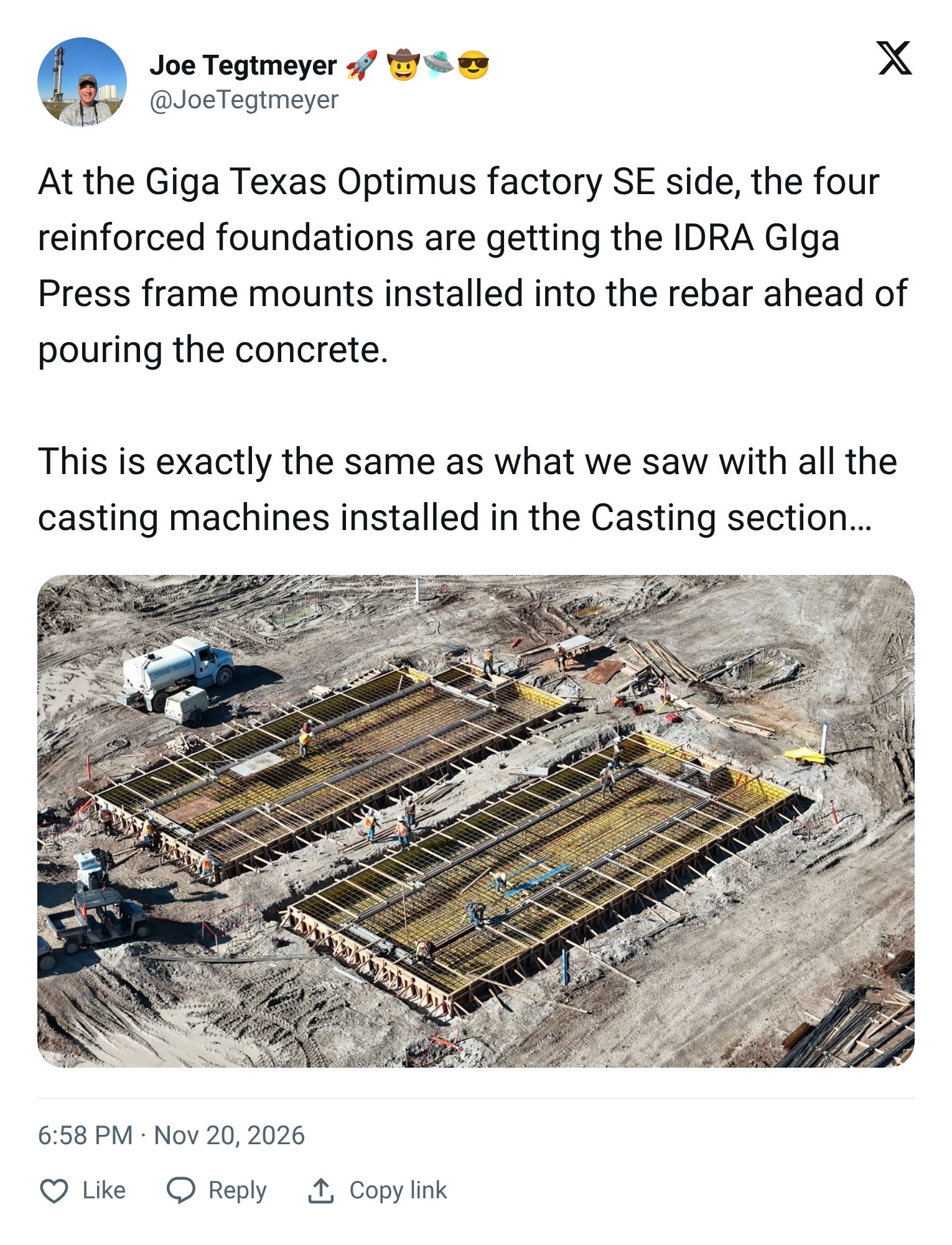
Gigacasting Optimus Parts?
Why would Tesla need such large die casting machines to produce parts for Optimus?
Producing tens of millions of robot parts per year requires a choice: either dozens of smaller die casting machines running 2-8 cavity molds, or fewer larger machines that can handle molds with 20-40 cavities. The bigger machines reduce the total number of machines and floor space needed while still delivering high volume output.
The main difficulty is not simply making more parts per shot. It is keeping the process under control once the die becomes very large and the number of cavities rises to dozens. On smaller machines of 400 to 1,500 tons, with two, four or six cavities, the process is manageable. Take, purely as an illustration, a 6,000 ton press running a die with dozens of cavities for Optimus parts: the complexity grows almost exponentially.
The first issue is flow balance. Molten metal has to reach every cavity as evenly as possible. Cavities close to the injection point fill first, which brings pressure spikes and flash, while those farther away receive too little intensification pressure and end up with shrinkage porosity and cold shuts. With two to four cavities this can be balanced well; with 20 to 40 or more, keeping it stable over thousands of shots becomes a very difficult fluid dynamics problem.
The second is the thermal management of the die. A die for a 6,000 ton press can weigh 50 to 100 tons or more, and keeping temperatures and cooling cycles uniform across every cavity is extremely difficult. Thermal gradients make the die expand unevenly, which distorts it, breaks the seal at the parting line and creates dimensional differences from one cavity to the next.

Thermal control units on current Tesla 6,000 ton machines
Such a die needs dozens of independent temperature control units, the devices that heat or cool each circuit of the tool, and even small imbalances are amplified on parts that need tight tolerances, such as the joint and actuator housings and the light structural elements of Optimus.
That is why it is up to Tesla's engineers to design parts that do not need very strict tolerances as cast, so they can be produced with low scrap rates and then machined only where precision is needed, in as few steps as possible to keep the process lean.
Building the die from several modules with replaceable inserts helps with quality, scrap and cost. Worn or damaged areas can be replaced without scrapping the whole die, critical features can be made as separate inserts that are easier to maintain and sometimes easier to control thermally, and design changes or process corrections can be limited to single inserts instead of the whole tool.
Modularity does not remove the core process risks, though: thermal gradients and flow balance affect the whole system, not just individual inserts, and cycle time does not scale in a straight line, because with such a large shot, cooling and extraction can take longer.
The goal is to produce many structural parts or housings in a single shot, reducing part count and cost at the very high volumes needed for millions of robots.
Many humanoid robot startups say their components need higher precision than automotive parts. Boston Dynamics even commented: "We machine our parts in house because we have such tight tolerances that nobody can make these parts". But Tesla is no beginner. To reach a $25,000 robot it needs cheap parts, made to tight tolerances with few processes, following the idea of making one product in one process, once.
One example is "painted" body panels that come straight out of the reaction injection moulding machine, a process in which two liquid components react inside the mould, with no need for an expensive paint shop. Optimus will use reaction injection moulding as well.

Tesla Optimus Humanoid Robot
Tesla Humanoid Robots will come sooner than most people think
The factory is the centrepiece of Tesla's humanoid robot plans. In Fremont, California, the Model S and Model X lines have gone offline while Optimus production lines are installed in their place, and in September Chinese media, citing unnamed sources, reported that Tesla teams had started Optimus oriented supply chain audits in Ningbo.
In Austin, the dedicated factory is planned for a capacity of 10 million robots a year, and aerial photos from August already showed, next to the tighter column grid of the multi level sections, wide bays large enough to take die casting and plastic injection moulding machines
Source: Joe Tegtmeyer on X — 20 November 2026

